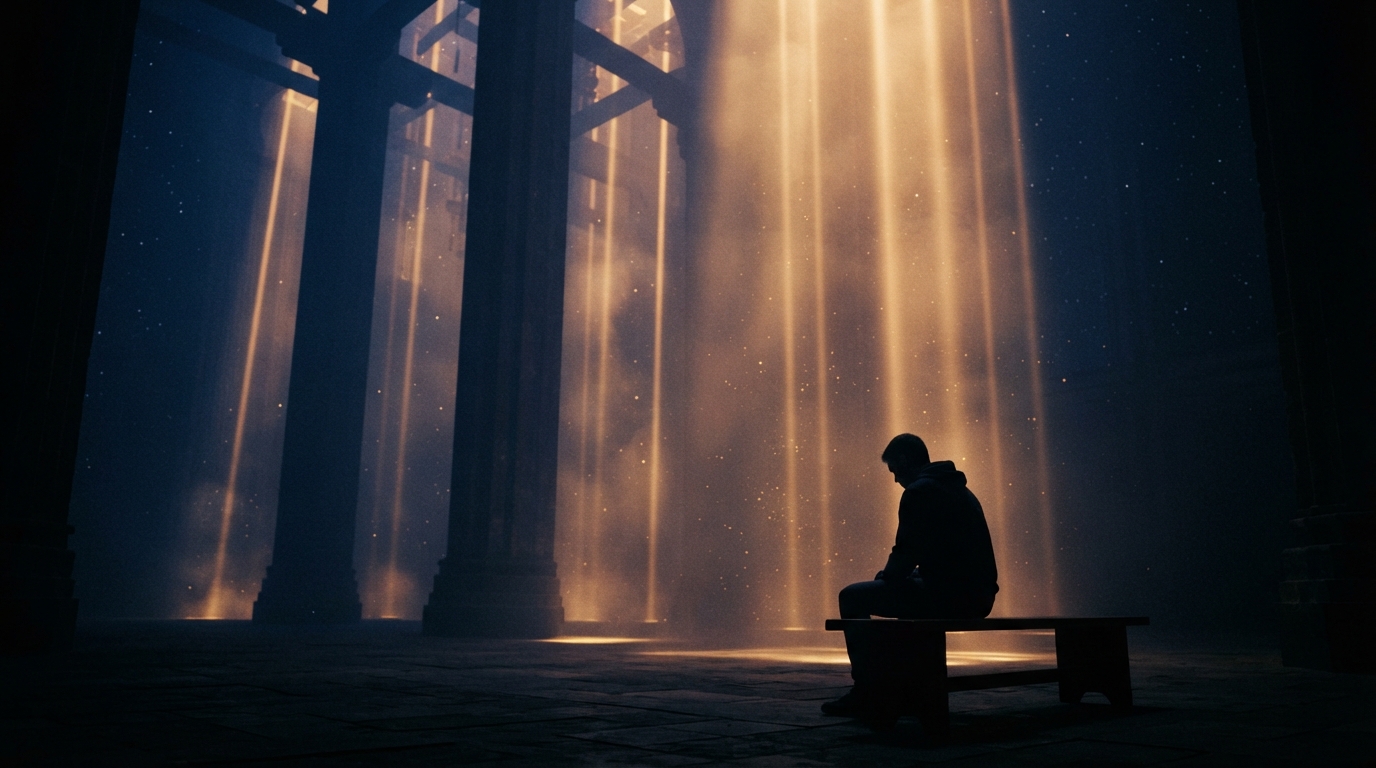
Stress elevates cortisol, which disrupts sleep architecture and keeps the brain in lighter, emotionally active stages — loading REM sleep with more unresolved material. The result is vivid, memorable dreams that mirror waking tensions: avoidance, loss of control, performance pressure. These aren't omens; they're the mind processing overnight what the day left unfinished.
When you're under pressure, your dreams get louder. Vivid chases, exams you can't finish, a fall with no bottom — the link between dreams and stress is one of the most reliable in all of sleep. The short version: elevated cortisol disrupts your sleep architecture, keeping the brain in lighter, more emotionally charged stages and giving REM sleep more raw material to work with. The result is dreaming that feels more intense, more fragmented, and easier to remember. None of it foretells anything. It's your mind sorting through what the day left unfinished.
This article does something different from the usual "types of stress dreams" list. It treats each recurring pattern as a psychological readout — a signal about how you're under strain, not a fortune. Being chased mirrors avoidance. Falling mirrors a loss of control. Exam dreams mirror performance pressure. Paralysis mirrors the freeze response. And the dream that returns to the same place points to something unresolved circling for attention. By the end, you'll have a small diagnostic rubric for reading your own dreams and stress together.
What Dreams and Stress Have to Do with Each Other: The Short Answer
Stress changes dreaming through the body first. When you're tense, your system runs higher on cortisol, the primary stress hormone. Cortisol keeps the brain more aroused, nudging sleep away from deep, restorative stages and toward lighter ones where dreaming is busier and closer to the surface. That's a large part of why stress causes vivid dreams — and why you wake remembering them. Understanding the relationship between stress and sleep is the first step in reading what these dreams are for.
A stress dream is a vivid, emotionally charged sleep experience in which the brain translates unresolved waking tension into imagery — not a prediction of events, but a live readout of what's still active in the emotional system.
There's a second half to this, and it matters. REM sleep isn't just where stress dumps its leftovers; it's where the brain works on them. During REM, levels of norepinephrine — another stress-related brain chemical — drop sharply, which lets emotionally loaded memories be reprocessed without their full emotional charge. Researchers at UC Berkeley described this as dream sleep "taking the sting out" of painful experiences. So the intensity you feel at 3 a.m. isn't malfunction. It's emotional processing in progress.
The catch is balance. When stress is chronic, cortisol stays elevated, sleep stays lighter, and the reprocessing system gets overloaded rather than relieved. Dream recall climbs, negative imagery crowds in, and mornings start to feel like they carry residue. The takeaway: stress doesn't add dreams so much as it turns up their volume and tilts their tone — which is exactly what makes dreams and stress worth reading together rather than separately.
How a Stressed Brain Converts Daily Tension into Dream Scenes
Dreams rarely restage your day literally. You don't dream the exact email that ruined your afternoon. Instead, the brain takes the emotion underneath it and builds a scene that carries the same charge. Psychologists call this emotional continuity: waking concerns are carried over into dream content. Research suggests that higher perceived stress is linked to more negatively toned dreams — consistent with this emotional continuity hypothesis. The feeling survives the translation even when the details don't, which is why your waking life stressors so often show up in disguise.
Emotional continuity, as defined in dream research, is the carry-over of waking emotional tone — worry, helplessness, pressure — into dream content: the feeling survives the overnight translation even when the specific events do not. It's why you don't dream the email itself, but wake carrying its dread.
So when people ask what causes stress dreams, the honest answer starts here: not the events themselves, but the unmetabolized emotion attached to them. That's also the short answer to the common anxiety dreams causes question — the dream is carrying a feeling that hasn't yet found resolution in waking life.
The threat-simulation loop
One well-known account of why this happens is threat simulation theory, proposed by cognitive scientist Antti Revonsuo at the turn of the millennium. The idea is that dreaming evolved in part as a rehearsal space — a way for the brain to run threats in a safe simulator, practicing recognition and response. Under stress, the amygdala (the brain's threat detector) runs hot, and that rehearsal skews toward danger. Neutral imagery gets pushed aside; threat-laden scenes take over the stage.
Seen this way, a stress dream is less a warning and more a drill. The sleeping brain is running emotional rehearsal on the thing that has your attention — an interview, a strained relationship, a deadline — and dressing it in whatever imagery fits the feeling. This is a large part of the psychological meaning behind why dreams intensify during stressful times rather than easing off.
Why do I have stress dreams that keep repeating?
Stress dreams repeat because the underlying material is unresolved. Sleep is also when memory consolidation happens — the brain files the day's experiences, tagging some as important. Emotionally intense, unfinished experiences get flagged for more processing, so they keep resurfacing until something shifts. That's the mechanism behind most recurring stress dreams: the loop stays open because the feeling stays open.
Consider a composite example: someone navigating a tense reorganization at work dreams, night after night, of a building whose rooms keep rearranging. The setting isn't the office. The helplessness is. As long as the waking situation stays unresolved, the brain keeps returning to the same emotional problem, trying different scenes on it. The pattern isn't stuck; the underlying feeling simply hasn't found its footing yet.
Five Stress Dream Patterns and What Each One Reflects
Here's where the readout gets specific. Five patterns show up again and again during stressful times, and each one mirrors a distinct way of being under strain. Reading these is the heart of stress dreams meaning — not a symbol dictionary, but a map of how pressure is landing on you.
Being chased or hunted
The classic. Something is behind you, gaining, and you can't turn to face it. Chase dreams most often mirror avoidance — there's something in waking life you'd rather not confront, so the dream personifies it as a pursuer.
In Jungian terms, what pursues us is frequently Shadow material: a disowned part of ourselves, a feeling or truth we keep at arm's length. The pursuer is menacing precisely because we won't turn around. A person avoiding a hard conversation with a partner may spend weeks being chased through empty streets. The chaser isn't a threat to decode — it's the conversation, wearing a costume.
Takeaway: a chase dream usually asks what you're running from, not what's running after you.
Falling or losing control
Falling dreams — or the related sensation of controls that won't respond, brakes that fail, a car you can't steer — mirror a loss of control. They tend to spike when life feels ungoverned: finances slipping, a plan unraveling, a role you no longer feel on top of.
There's often a note of what could be called ego destabilization — the sense that the structure you stand on is less solid than you thought. The fall dramatizes the fear of not being able to catch yourself. Takeaway: falling points to where you feel you've lost your footing, and quietly asks where you might reclaim some.
Failing a test or missing something critical
You're back in an exam you never studied for. You're on stage without lines. The train leaves as you reach the platform. These dreams mirror performance anxiety — the pressure of being evaluated, of not measuring up, of a standard you're afraid you'll miss.
Revealingly, these dreams visit people who are competent, often before high-stakes moments. A seasoned professional the night before a big presentation dreams of failing a school test decades behind them. The scene is old; the pressure is now. Takeaway: exam dreams track the fear of falling short, usually where you care most about doing well.
Being frozen or unable to move
You need to run, or scream, or act — and your body won't obey. Paralysis dreams mirror the freeze response, the body's third answer to threat alongside fight and flight. When a waking situation feels both urgent and impossible to act on, the nervous system's freeze can echo straight into the dream. These are among the most physically distressing stress nightmares, precisely because the fear lives in the body rather than the plot.
This is best read at the somatic layer rather than as symbol. The felt sense of being stuck — the held breath, the locked limbs — is the body carrying an activation it couldn't discharge. A person trapped in a situation with no clear exit may dream of being pinned in place. Takeaway: paralysis dreams point to where you feel unable to act, and to a tension the body is still holding.
Returning again and again to the same stressful place
Some dreams keep rebuilding the same setting — a childhood house, a former job, a specific room. Recurring stress dreams of this kind mirror what psychoanalysis calls repetition compulsion: the mind circling back to unresolved material, replaying it in search of a different outcome.
In gestalt terms, this is an unfinished gestalt — a scene left open, demanding closure the waking situation hasn't offered. The dream doesn't repeat to torment you; it repeats because the emotional business is genuinely unfinished. Takeaway: a recurring setting marks unresolved material, and asks what closure is still missing.
Stress Dream Patterns at a Glance
| Dream Pattern | Typical Waking-Life Trigger | Psychological Mechanism | One Thing to Notice |
|---|---|---|---|
| Being chased | Something you're avoiding facing | Avoidance; Shadow material | What you're running from, not what's chasing |
| Falling / losing control | A situation slipping out of your hands | Loss of control; ego destabilization | Where your footing feels unsteady |
| Failing a test | A high-stakes evaluation ahead | Performance anxiety | Where you most fear falling short |
| Frozen / can't move | Urgent problem you can't act on | Freeze response; somatic activation | The tension your body is still holding |
| Same place returning | An unresolved, looping situation | Repetition compulsion; unfinished gestalt | What closure is still missing |
Read down the last column: each pattern points not to a fixed meaning but to a question worth sitting with. That's the difference between a dream dictionary and reading dreams and stress as a live signal about your inner state.
How to Recognize Your Own Pattern
A table can only get you halfway. The real work is matching a pattern to your week — and that takes a little structured self-reflection. Dream journaling helps here: even a few phrases jotted down on waking preserve the emotional texture that fades within minutes of opening your eyes.
Three questions to ask after a stress dream
- What feeling dominated the dream? Not the plot — the emotion. Dread, helplessness, exposure, panic, grief. The waking emotion you carry into the morning is the truest clue to what the dream was processing.
- What was I avoiding or losing? Chase and freeze dreams tend to hide an avoidance; falling and failing dreams tend to hide a loss or a fear of one. Name it plainly.
- What in my current waking life mirrors that? Line the dream's feeling up against your actual waking life stressors. The match is usually quieter and more specific than you expect.
Pay attention, too, to the body sensation on waking — a tight chest, a held breath, a restless jaw. That felt sense often names the stress more accurately than any interpretation, and it sharpens your self-awareness faster than analysis alone.
When the pattern shifts: what that signals
Patterns move. If your dreams migrate from being chased to falling, the underlying stress may be shifting from avoidance toward loss of control — often a sign a situation has stopped being something you can dodge and started being something you're inside of. A shift from failing-a-test dreams toward frozen dreams can mean pressure has tipped past "I might not measure up" into "I can't act at all." The direction of change carries its own psychological meaning; track it the way you'd track a symptom easing or worsening, not as an omen.
When a Dream Is Worth Exploring More Carefully
Most stress dreams pass as the pressure behind them passes. But when the same pattern recurs across weeks, or the emotional residue lingers well into the day, that's worth sitting with rather than shrugging off — it can be an early signal of chronic stress or approaching burnout, not just a rough night. If you'd like to look at one of your own dreams through the six lenses — Jungian, psychoanalytic, gestalt, somatic, systemic, and symbolic — you can explore the Dream Keeper blog or bring it to the Dream Keeper bot (@Dream_Keeper_origin_bot) and see what each angle surfaces. No single reading is the final word; together they tend to show you the feeling you already half-knew was there.
A Note on What Dream Interpretation Is — and Isn't
Interpreting a dream is a prompt to reflect on yourself, not a prediction of the future and not a medical diagnosis. A stress dream doesn't foretell an event, and no image "always means" one fixed thing — the same scene can carry different weight for different people. If feelings stirred by a dream — or by the stress underneath it — start to feel hard to carry, the kindest and wisest step is to talk them through with a psychologist or doctor. Your dreams can point you toward what needs attention; the care itself belongs in waking life, with people who can walk it with you.