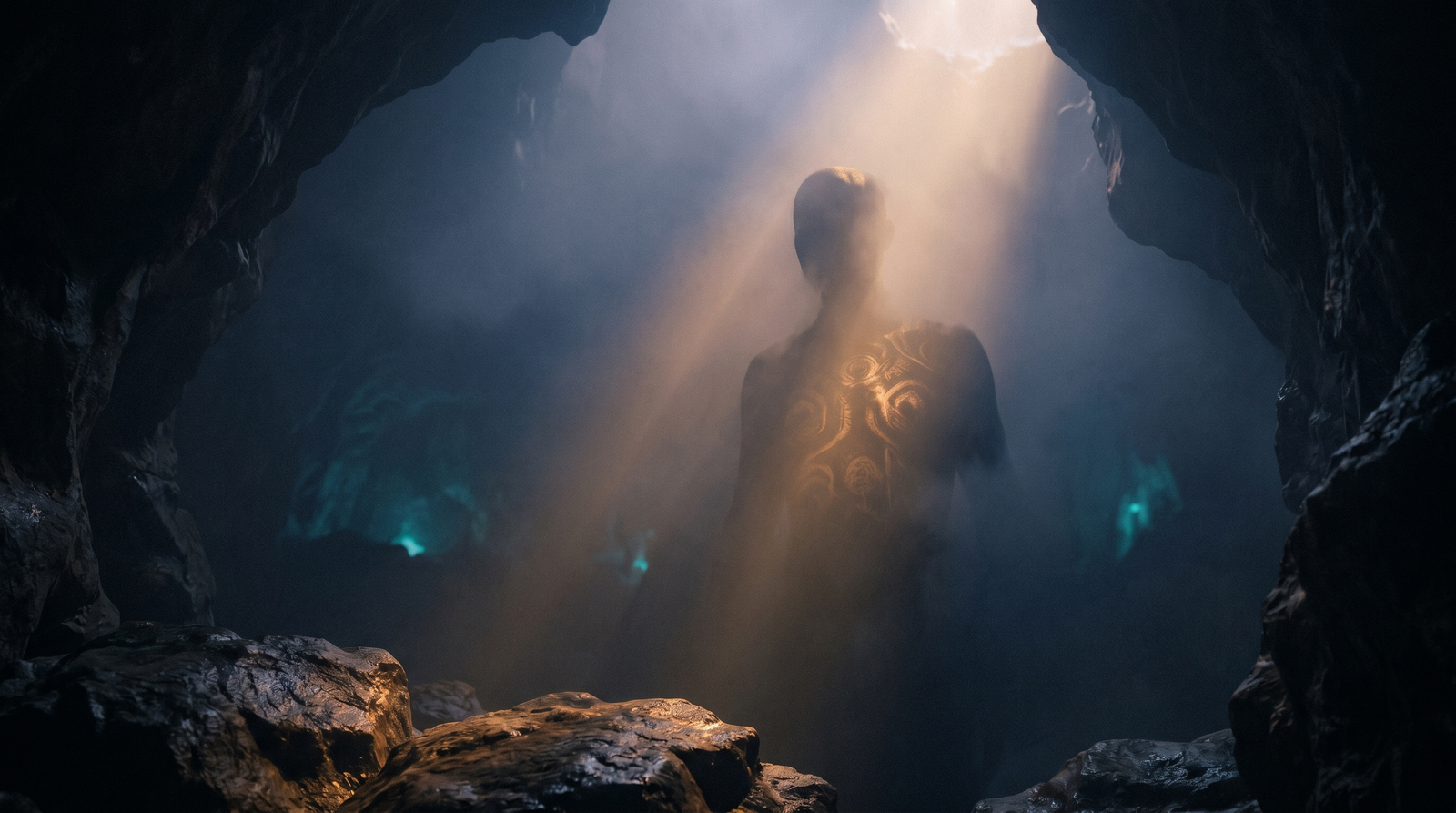
Jungian dream analysis treats each image as a message from the unconscious rather than a fixed omen. A symbol has no universal meaning; its sense depends on the dreamer's personal context, so the same image reflects different inner states in different people. The aim is to understand what an image may be saying about you.
Jungian dream analysis is not a dictionary of "what it means to dream of a road or a stranger" — it's a method for understanding what a dream image is saying about you. In analytical psychology a dream is working material for the psyche, not an encrypted forecast with fixed answers. C. G. Jung's approach to dreams rests on a simple premise: the same symbol means different things to different people, and you can only decode it through the dreamer's own context.
This article isn't a list of interpretations. It's the method in motion. Using two fictional cases, we'll show how a Jungian reading works where ordinary dream books offer only a glossary of words — through the Shadow, through the call of the Self, through the collective unconscious living inside a deeply private dream.
What Jungian dream analysis is — and how it differs
An ordinary dream book is built like a lookup table: image equals meaning. See water — "news is coming." Lose a tooth — "a loss is near." Jung's approach is built differently, and it essentially refutes the whole idea of that table.
A Jungian reading assumes the dream speaks to you in its own language — the language of images, not ready-made answers. So it begins not by hunting for a meaning in a list, but with a question: what does this image mean for me, in my life, right now.
Jungian dream analysis is a psychological method in which an image's meaning is set by the dreamer's personal context, not by a universal catalog of symbols. The same symbol mirrors different inner states in different people, which is exactly why analytical psychology has no "image equals meaning" chart. The reading is always tied to one specific person's history.
Takeaway: the unit of meaning isn't the symbol — it's the symbol plus the particular life it appears in.
The dream as the language of the unconscious
For Jung a dream is neither deception nor random brain noise, but a message from the unconscious expressed in symbols. The central idea of his theory is the compensatory function of dreams: the dream balances a one-sided conscious attitude and restores the psyche's equilibrium.
If by day you're too hard on yourself, a dream may show you mercy. If you overrate your confidence while awake, a scene of helplessness may arrive at night. The dream finishes the sentence consciousness has cut off or refused to notice.
That changes everything. The image stops being a "sign of fate" and becomes a mirror of an inner state — and the mirror is individual. Water is dread for one person and the calm of a childhood riverbank for another.
Interestingly, empirical dream research partly echoes this. A modern review of the evidence notes that across a single night one leading emotional theme is reworked again and again, and that content stays remarkably stable even over many nights (Jung's Theory of Dreaming, PMC). The psyche really does seem to be finishing something in the dark.
Takeaway: read a dream as compensation — what is it adding to, or correcting in, your waking attitude?
Why Jung never gave "what it means to dream of…" lists
Here is the key paradox of a Jungian reading: Jung himself warned against a dictionary approach to symbols. An image's meaning, he insisted, is fixed by the dreamer's personal context, never by a universal key. That runs directly against the genre of traditional dream books.
Instead of Freud's free association — where you drift from the image into a chain of personal memories — Jung proposed amplification. The move is to hold on to the specific dream image and seek parallels in myths, fairy tales, and cultural symbols across eras, without dissolving the image into stray recollections.
So an honest Jungian reading isn't a table — it's a way of asking questions. Below we put it to work: two scenarios, two readings, without a single "this means money."
Takeaway: keep the image intact and amplify it outward to shared human imagery, rather than reducing it to a stock meaning.
Case one: the Shadow in the figure of a stranger
The story below is composite and fictional; any resemblance is coincidental.
To make the method concrete, let's start with the most common motif in anxious dreams — a threatening, unfamiliar figure. A dream stranger is rich material, because the Shadow shows through it clearly.
A woman dreams she's walking home down a familiar street. Footsteps behind her. She turns and sees a stranger: dark clothes, a face she can't make out. He doesn't attack, but he follows, stubbornly, never falling back. She speeds up; so does he. She wakes mid-breath, heart pounding.
An ordinary dream book would say something about "enemies" or "bad news." A Jungian reading is in no hurry to pass sentence. It asks instead: who is this stranger to the dreamer herself?
In analytical psychology, a pursuing figure of the same sex as the dreamer is often linked to the Shadow — the symbolic appearance of repressed parts of the personality: qualities, wants, and reactions a person won't acknowledge and therefore strips of a "face." The Shadow is dark not because it's evil, but because it's been pushed into the dark, where consciousness prefers not to look.
A dream stranger, then, is frequently not a stranger at all but the most intimate thing: a split-off, disowned part of one's own self. The harder we deny it awake, the more insistently it catches up with us in sleep.
In conversation it emerged that the woman had forbidden herself anger for years. She'd judged it "ugly," staying agreeable and soft. The threatening pursuer is a plausible image of that very suppressed force, asking at last to be seen.
Takeaway: when a same-sex figure menaces you in a dream, ask what part of yourself you've exiled — not who the "enemy" is.
Integrating the Shadow rather than fighting it
A Jungian reading doesn't suggest you "outrun" the pursuer. The opposite — turn toward him. What is he doing? What does he want? What happens if you stop and look him in the face?
That is integration: not a war against the disowned part, but its return into conscious life. Granting yourself the right to anger doesn't mean snapping at people. It means no longer spending energy holding a door shut.
In suppressed anger there's often a healthy capacity to protect your own boundaries. The frightening image turned out to be an invitation to a conversation with oneself, not a prophecy of harm. The same stranger in another person's dream would mean something else entirely — which is the whole point of a Jungian reading, where archetypes always show up individually.
Takeaway: the goal isn't to defeat the Shadow but to reclaim what it carries — including its useful strength.
Case two: the road home and the call of the Self
This story is also composite and fictional; resemblances are coincidental.
The first case was about what we reject in ourselves. The second is about what we move toward. Here the Self and the collective unconscious come into play.
A man dreams the same dream month after month. He's walking a road toward a house he doesn't know awake, yet in the dream he's certain: this is his home, and he needs to return to it. The road is long, sometimes winding, sometimes breaking off. He almost never reaches the door — he wakes on the approach. And the feeling left behind isn't anxious but beckoning.
A recurring dream is a particular kind of signal. It's rarely random: the psyche keeps coming back to one theme until it's been lived through.
In a Jungian lens, an unfamiliar yet "own" house is often linked to the Self — the center and the wholeness of the psyche at once, an image of the completeness a person moves toward. The road to the house is an almost literal metaphor for individuation: the process of becoming oneself, of joining the conscious and the unconscious. Individuation isn't a one-off insight but a long work of assembling a self from its parts.
That the dreamer never reaches the door isn't a failure. Individuation doesn't promise a final point where "everything is achieved." It's a path — and the dream honestly shows that the path is underway.
This man was in a season of change: switching careers, asking again who he was. The dream of coming home answered his central inner question — where am I really going, and what does "home" mean for me.
Takeaway: a recurring dream often marks a live psychological process, not a verdict — read its direction, not its "omen."
What the research adds
Empirical work backs this up. Christian Roesler's research project Structural Dream Analysis (2020) found that patients' serial dreams in Jungian therapy follow one or two recurring patterns directly tied to their psychological problems — and that shifts in those patterns coincided with therapeutic improvement (Journal of Analytical Psychology, Wiley).
Serial dreams, in this view, aren't accidental repeats but a single theme the psyche plays out again and again. That's a strikingly empirical confirmation of an idea Jung reached clinically.
Takeaway: recurring dream patterns track real inner change, which is why their shifts can mirror progress.
The collective unconscious inside a personal dream
Why is "the road home" so recognizable to very different people? Jung explained it through the collective unconscious — a layer of the psyche shared by all, where the archetypes live: inherited images of human experience.
The collective unconscious surfaces precisely through such universal motifs: the path, the home, the threshold, the return. That's why a deeply personal dream can suddenly sound like an ancient story everyone knows.
The road home echoes the monomyth — the hero's return as the close of the journey. In myth the hero departs, endures trials, and comes back changed. The home at the end is no longer the point he set out from but a symbol of a wholeness he's earned.
Takeaway: when a private dream feels archetypal, you're touching shared human imagery — that resonance is a feature, not a coincidence.
What a Jungian reading gives you in practice
From both cases a single principle stands out. This method doesn't hand back a ready answer — it returns the question to the dreamer. Analytical psychology works less like a reference book and more like a conversation: you hold the image, view it from several sides, and link it to the dreamer's life.
If you want to do a reading in this spirit yourself, start with three questions for each key image:
- What feeling does the image bring up? Not "what does it mean," but what you sense beside it — fear, longing, warmth, pull.
- Where does this already exist in my life? What this image or emotion rhymes with, awake, right now.
- What might the image be compensating for? What consciousness overlooks or avoids — what the dream could be "finishing."
These three questions are a scaffold for self-knowledge through dreams. They don't deliver a final decoding; they start a process in which meaning is made, not looked up in a table.
Takeaway: trade the dictionary for three questions, and the dream becomes a dialogue instead of a verdict.
Why one symbol can mean different things
Here's how the method handles "popular" images — not "water equals news," but a set of questions to yourself:
- Water. Does it bring threat or calm? What does water mean in your life?
- A road. Where are you going, and by your own choice? Does the path feel chosen?
- A house. A refuge or a trap? Which season of life is this house tied to?
- A pursuer. What are you running from awake? What happens if you turn around?
- Falling. Where in reality are you losing footing or control?
- Losing teeth. Where do you fear "losing face" or feeling powerless?
- An unknown child. What new or vulnerable thing in you needs care now?
The same symbol opens differently for two people because each answers from their own, unrepeatable life. That is the whole difference between analytical psychology and any dictionary dream book.
Takeaway: keep the symbol, change the questioner, and the meaning changes with them.
Reading your dream through six lenses — and a gentle note
The Jungian view is powerful, but not the only one. In Dream Keeper it's one of six lenses for looking at a single dream: alongside the Jungian sit the psychoanalytic, the gestalt, the somatic, the systemic-family, and the symbolic-mythological.
If the method in this article speaks to you and you'd like to look at your own dream this way, you can describe it to the bot @Dream_Keeper_origin_bot and get a psychological reading from several angles at once. Not "what does it foretell," but what the image may be saying about you.
And to close — gently but honestly. Interpreting a dream is a prompt to reflect on yourself, not a forecast of the future and not medical advice. A dream can point a direction, but you make the decisions. If feelings from the dream or from waking life are hard to carry, the kindest thing is to talk them through with a psychologist or doctor — a living specialist always goes deeper than even the most attentive reading.